
AI Tools
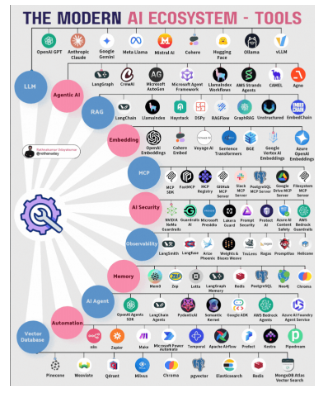
The Modern AI Ecosystem – Tools diagram presents the modern AI landscape as a collection of interconnected layers and capabilities. Rather than being built around a single model or platform, modern AI systems combine specialized tools for intelligence, data retrieval, storage, automation, safety, observability, and deployment. Each category plays a different role in turning AI models into complete, production-ready solutions.
1. LLM — The Core Intelligence
Large Language Models (LLMs) form the foundation of the modern AI ecosystem. These models are responsible for understanding and generating human language, reasoning over information, answering questions, writing content, and supporting conversations. The ecosystem includes a variety of commercial and open-source models, allowing organizations to choose models based on factors such as performance, cost, privacy, language support, and deployment requirements. However, an LLM alone is rarely enough to build a complete AI solution, which is why it connects to the other layers in the ecosystem.
2. Agentic AI — Autonomous Task Execution
Agentic AI introduces the ability for AI systems to move beyond simply generating responses and instead take actions to achieve specific goals. AI agents can break down complex tasks, make decisions, plan workflows, access tools, retrieve information, and execute multiple steps with limited human intervention. The growing number of agent frameworks and platforms reflects the increasing importance of building AI systems that can act as digital workers, assistants, and autonomous problem-solving systems.
3. RAG — Connecting AI to Knowledge
Retrieval-Augmented Generation (RAG) enables AI systems to access external and organization-specific knowledge. Instead of relying only on the information contained within an LLM, RAG retrieves relevant documents, databases, or knowledge sources when a user asks a question. This information is then provided to the model as context for generating a response. RAG is especially important for enterprise AI applications because it allows organizations to build assistants that can answer questions using current, private, and domain-specific information.
4. Embeddings — Representing Meaning
Embedding technologies convert text, images, and other forms of data into numerical representations that capture their meaning and relationships. Instead of searching for exact keywords, AI systems can use embeddings to identify information that is conceptually similar. Embeddings form a critical part of semantic search and RAG architectures, helping systems understand that different words or phrases may express similar ideas. They provide the bridge between human information and the mathematical representations used by AI systems.
5. MCP — Standardized AI Connectivity
The Model Context Protocol (MCP) represents an emerging approach to connecting AI models and agents with external tools, data sources, and services through standardized interfaces. Rather than building a completely new integration for every application, MCP aims to make it easier for AI systems to discover and use external capabilities. This creates a more modular ecosystem where models and agents can interact with databases, APIs, files, enterprise systems, and other digital tools in a consistent way.
6. AI Security — Protecting AI Systems
AI Security focuses on protecting AI models, applications, data, and users from risks and vulnerabilities. As AI systems gain access to sensitive information and external tools, security becomes increasingly important. AI security tools can help organizations manage issues such as prompt injection, unauthorized access, data leakage, malicious inputs, insecure integrations, and model misuse. This layer ensures that AI systems are not only capable but also protected against threats.
7. Observability — Understanding AI Performance
Observability tools allow developers and organizations to monitor what happens inside an AI application. They can track prompts, model responses, tool calls, retrieval quality, latency, token usage, errors, and overall system behavior. This visibility is essential when deploying complex systems involving LLMs, RAG pipelines, and AI agents. Observability helps teams identify problems, understand system behavior, optimize performance, and continuously improve their AI applications.
8. Memory — Giving AI Context Over Time
Memory enables AI systems, particularly agents and conversational applications, to retain useful information across interactions. Instead of treating every request as completely independent, a system with memory can maintain context about previous conversations, user preferences, tasks, or actions. Memory can be short-term, supporting the current conversation, or long-term, allowing the system to retain relevant knowledge over time. This capability is essential for creating more personalized, consistent, and context-aware AI experiences.
9. AI Agents — Coordinating Tools and Actions
The AI Agent layer focuses on frameworks and platforms used to build systems that can reason, plan, use tools, and execute workflows. Agents sit at the center of many modern AI architectures because they coordinate multiple capabilities, including LLMs, RAG systems, APIs, memory, and external applications. An agent can determine what needs to be done, select the appropriate tools, execute actions, evaluate the results, and continue until a task is completed.
10. Automation — Integrating AI into Workflows
Automation platforms connect AI capabilities with business processes and digital workflows. They allow organizations to trigger actions based on events, connect multiple applications, move information between systems, and automate repetitive tasks. When combined with AI agents, automation tools can enable systems to not only understand and generate information but also take meaningful action across an organization's technology environment.
11. Data Infrastructure — The Foundation for AI
Modern AI systems depend on strong data infrastructure. This includes databases, data warehouses, APIs, storage systems, and platforms that make information available to AI applications. Data infrastructure ensures that AI systems can securely access, process, retrieve, and manage the information they need. Without reliable data systems, even the most advanced AI models have limited ability to provide useful and accurate results.
12. AI Evaluation — Measuring Quality and Reliability
AI evaluation tools are used to measure how effectively an AI system performs. They assess factors such as accuracy, relevance, faithfulness, safety, consistency, latency, and task completion. Evaluations are particularly important because AI systems can produce outputs that appear convincing but may be incorrect or unreliable. By systematically testing AI applications, organizations can identify weaknesses, compare different models or approaches, and improve system quality over time.
13. AI Governance — Managing Responsible AI
AI Governance provides the policies, controls, and accountability mechanisms needed to manage AI responsibly. It addresses issues such as compliance, privacy, transparency, risk management, model usage, data governance, and human oversight. As AI becomes more deeply integrated into organizational processes, governance ensures that its use aligns with legal requirements, ethical principles, and organizational objectives.
14. AI Safety — Setting Boundaries and Guardrails
AI Safety focuses on ensuring that AI systems behave within acceptable and defined boundaries. Safety tools and frameworks can help prevent harmful outputs, restrict unauthorized actions, protect sensitive data, and enforce organizational policies. This becomes particularly important for autonomous agents that can access external systems and perform actions. AI safety ensures that greater autonomy does not result in uncontrolled or unpredictable behavior.
Overall Perspective
The diagram shows that modern AI is not just about choosing the best LLM. Building a real-world AI solution requires an ecosystem of technologies working together. LLMs provide intelligence; RAG and embeddings provide access to knowledge; data infrastructure stores and manages information; agents and automation enable action; MCP connects systems; memory provides continuity; observability and evaluation measure performance; and security, governance, and safety ensure responsible operation.
Together, these layers form the modern AI ecosystem, transforming a standalone AI model into a complete, scalable, secure, and production-ready AI system.
No comments to display
No comments to display