
Multi-Agent Design
Use role-based agents instead of one omnipotent agent.
Agent |
Responsibility |
|
Planner |
Break down tasks |
|
Researcher |
Retrieval |
|
Executor |
Tool use |
|
Verifier |
Check outputs |
|
Safety Agent |
Policy checks |
|
Finance Agent |
Budget controls |
|
Audit Agent |
Logging |
Orchestration Patterns
● Manager-worker — a coordinator agent dispatches to specialist workers and merges results.
● Task graph / stateful graph orchestration — the workflow is modeled as a directed (often cyclic) graph with conditional branching, persistent checkpoints, and interruptible human-in-the-loop points, rather than a fixed linear chain.
Open problem: Byzantine fault tolerance in adversarial multi-agent settings remains an unresolved research area — don't assume agent-reported results are trustworthy without independent verification in high-stakes settings.
Model Routing / Cost Optimization
Use the cheapest model that can reliably complete the task.
Tasks |
Model Tier |
|
Classification |
Small |
|
Summaries |
Small / Medium |
|
Planning |
Medium / Large |
|
Coding |
Specialist |
|
Verification |
Large |
|
Legal / Compliance |
Premium deterministic |
Principle: Intelligence should scale with difficulty. Many current model families additionally expose configurable reasoning effort as a routing dimension in its own right — treat effort level as a tunable dimension alongside model size.
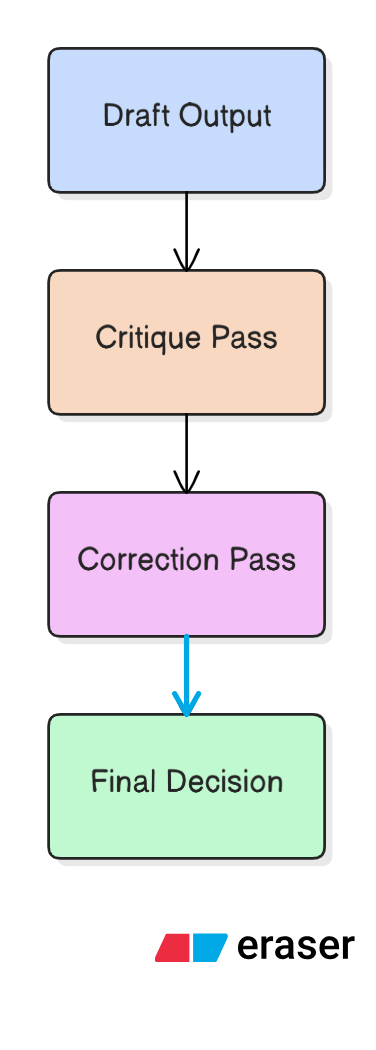
Reflection / Critique Loops
Use secondary reasoning for high-stakes decisions.
Trigger Conditions
● Low confidence
● High risk
● Contradictory evidence
● Large transaction
● Compliance-sensitive request
Reflection Flow
Human-in-the-Loop Design
Humans should be inserted intelligently.
Human Role |
Tasks |
|
Reviewer |
High-risk decisions |
|
Supervisor |
Real-time override |
|
Trainer |
Correct outputs |
|
Auditor |
Compliance review |
Confidence Handoff: Escalate when confidence < 0.85–0.90
No comments to display
No comments to display